
Group workshops
View allBuilding a Family Culture of Problem-Solving
Setting and Achieving Family Goals
Family goals work better when everyone has a voice.
Practice making decisions with your children, not just for them. Drawing on collaborative problem-solving and motivation research, turn everyday friction into shared goals and manageable next steps.
Next session
Thursday, January 21 at 10:00 AM PST
60 minutes · $79
- Format
- Live online workshop
- Duration
- 60 minutes
- Facilitator
- Sabrina Briceño, LPCC
- Price
- $79
For parents, co-parents and caregivers. Come on your own or together.
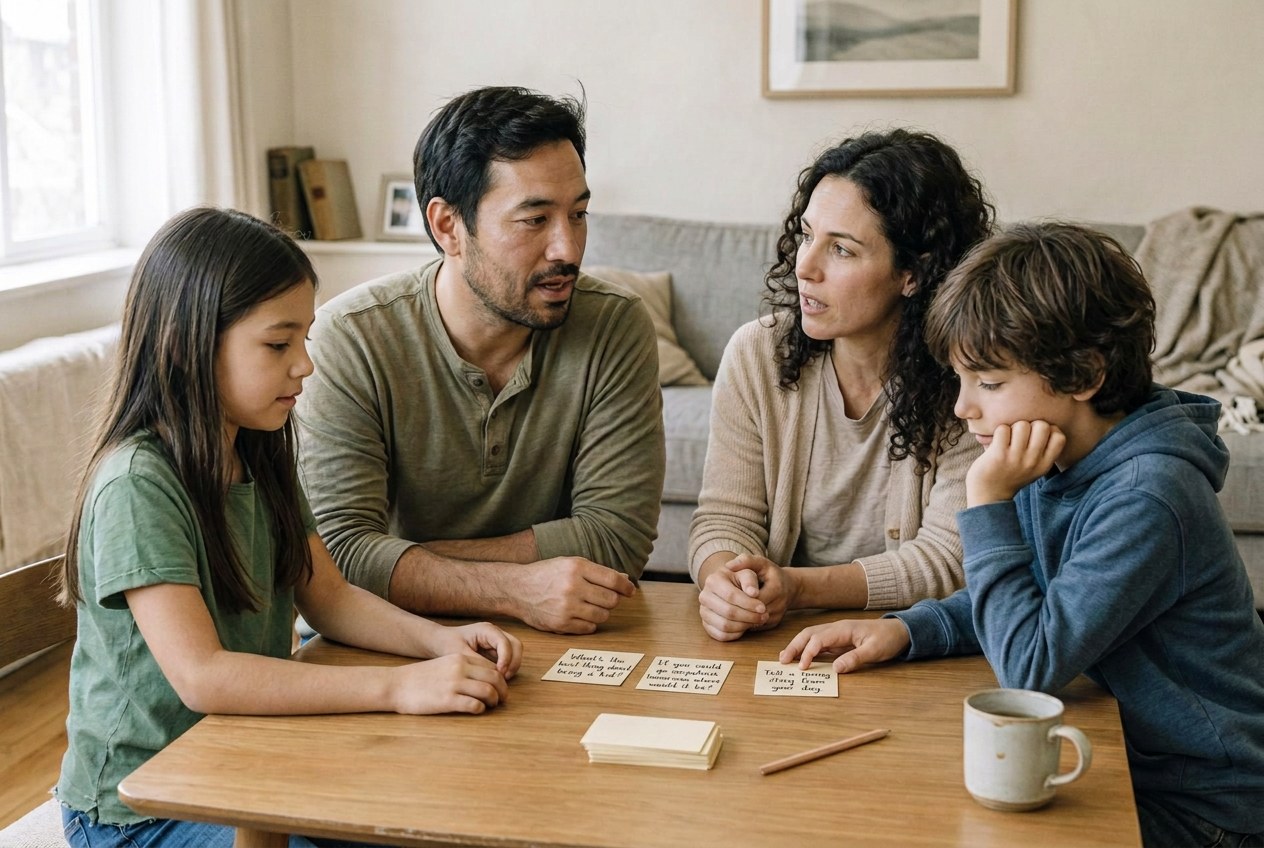
Does this sound familiar?
You're the one making the plans, and the one reminding everyone to follow them.
A conversation about chores becomes an argument about fairness.
You want your children involved, but family decisions keep turning into a tug-of-war.
What we'll explore
- Building a family culture where problems can be discussed without blame.
- Listening to each person's concerns before deciding on a solution.
- Setting shared family goals that are specific, realistic and meaningful to everyone.
- Breaking goals into small steps and sharing responsibility in age-appropriate ways.
- Checking progress together and changing the plan when it isn't working.
The research behind it
This curriculum draws on established relationship research, not generic advice. A few of the findings we build on:
Collaborative problem-solving starts by understanding a child's concern, naming the adult's concern and inviting a solution that addresses both.
Ross W. Greene, Raising Human Beings (2016)
Self-determination theory identifies autonomy, competence and relatedness as important supports for motivation. Meaningful participation is different from simply being told what to do.
Richard Ryan & Edward Deci, Self-Determination Theory (2017)
What you'll leave with
- A structure for a short family problem-solving conversation.
- One shared family goal with clear next steps and a check-in plan.
- Questions that invite children into decisions rather than demand agreement.
Plus a reflection workbook, one concrete action to practice, and a seven-day follow-up exercise by email.
Meet your facilitator

Sabrina Briceño, LPCC
Licensed professional clinical counselor · Founder of Chapter
Sabrina turns current relationship research into plain words and practical skills, with warmth and without jargon.
She holds a Master's in Professional Clinical Counseling with a focus in social justice from the University of San Francisco, and has practiced in public and private settings in San Francisco and Denver.
Her work draws on the Gottman Method, Emotionally Focused Therapy and attachment research, and builds goal-setting and accountability into the work. She is licensed in California and Colorado, and holds space for clients of every identity.
Practical details
Each workshop is capped at 10 people max, so there is room for real conversation.
On your own or with someone
Come by yourself, or bring your partner, a friend or a family member. Nothing in the session assumes you're a couple.
Camera on or camera off
Keep your camera off if you'd rather listen than be seen. You can still type, and no one will single you out.
Participation is optional
Speak when you want to and pass when you don't. You're never called on.
No judgment
This is a room for learning, not performing. Share as little or as much as you like.
Reserve your spot
Payments in the preview are in test mode.